

Methodology
An Official Statistics Publication for Scotland
Published on 30th September 2025
Data collection and reporting
SEPA’s role
We collect and quality assure (QA) the SPRI data and then make it publicly available.
SPRI data is retained by the operators who bear the legal responsibility to ensure the accuracy of the information supplied. Our QA process is there to check that the data is complete, coherent and suitable for publication. In outline:
We carry out data checks using historic data from the facility and similar facilities.
Where data is flagged in our checking process, we may ask the operator to confirm their figures and provide more detail on the reasons for any variations. We also ask SEPA’s site officers to cross reference against other available data and to use their knowledge of the facility to assess whether information is credible.
We carry out a set of crosschecks against other SEPA data sources – for example the Emissions Trading System data on carbon dioxide emissions. We check that accidental releases have been notified to SEPA where appropriate.
The overall data for each industry sector is reviewed by colleagues who have substantial knowledge of the facilities and their processes, to help us understand each individual return’s place in the sector.
Once data has been through QA, we will submit the required sub-set to Defra, who will use it in the UK Pollutant Release and Transfer Register (UK-PRTR). Defra will carry out further checks and inform us of any issues they identify.
Sub-sets of SPRI data are used to fulfil national and international reporting obligations (e.g. UK National Atmospheric Emissions Inventory), and these will often have their own QA processes which provide us with feedback.
Note that we do not use SPRI data to assess regulatory compliance.
Notes on total emissions data
All values are in kilograms, with the exceptions of carbon dioxide to air which is given in tonnes (equivalent to 1,000kg) in some figures to simplify reporting.
All pollutants in SPRI have a reporting threshold value, as reported in the Schedule. If a facility’s emission is below this value, they report only ‘BRT’ (Below Reporting Threshold), although they may voluntarily provide a numerical value. If emissions are ‘ART’ (Above Reporting Threshold) they must supply us with a value. See Figure M1 and Figure M2 for a breakdown of ART and BRT reporting. Figures for total emissions and number of reporting facilities provided in this document are for ‘ART’ submissions only.
Percentage figures given to show the proportion of total emissions from each industrial sector are rounded so may not total 100%.
Precision of figures. Operators are asked to supply figures to three significant figures. Many provide more precise figures, and we have used these here. For some official reporting we are required to round each individual value to three significant figures which may cause slight discrepancies from the totals reported here.
There are ten SPRI industry sectors, but only sectors with emissions of the pollutants listed in the emissions tables in the Summary section are reported. For details of the activities which place a facility within a sector, including the minimum capacity a facility must have to be required to report to SPRI, see Table M1.
More detailed data on waste transfers are available on the SEPA website, which provides extensive reporting on waste data for Scotland.
The thresholds for reporting offsite waste transfers are 2 tonnes for hazardous and 2,000 tonnes for non-hazardous. No ‘BRT’ report is necessary as it is assumed all facilities will produce some waste.
“Disposal” and “Recovery” mean any of the operations provided for in Annex IIA and Annex IIB of EU Waste Directive 2006/12/EC
Which greenhouse gases are reported in SPRI and how do they contribute to global warming?
The greenhouse gases reported in SPRI are carbon dioxide, methane, nitrous oxide and three fluorinated greenhouse gases (F-gases): hydrofluorocarbons, perfluorocarbons and sulphur hexafluoride. Note that the Kyoto ‘basket’ of greenhouse gases includes nitrogen trifluoride (an F-gas) which is not reportable to SPRI.
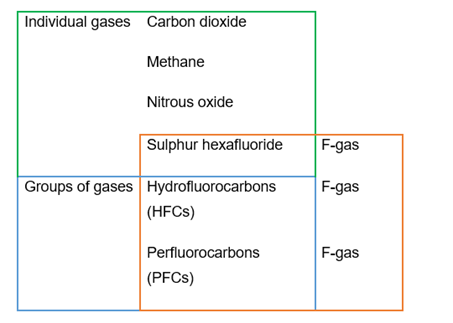
The ‘F-gases’ are a family of chemicals that contain fluorine which are also powerful greenhouse gases that contribute to climate change. The UK has a regulation on the use of F-gases like hydrofluorocarbons (HFCs), perfluorocarbons (PFCs) and sulphur hexafluoride (SF6).
Thes greenhouse gases reported to SPRI are weighted using Global Warming Potentials (GWP) to express emissions on a consistent basis in terms of carbon dioxide equivalent (CO2e).
The Intergovernmental Panel on Climate Change (IPCC) explains Global Warming Potentials as: “Global Warming Potentials (GWP) are calculated as the ratio of the radiative forcing of one kilogramme greenhouse gas emitted to the atmosphere to that from one kilogramme CO2 over a period of time”.
The GWP values used in this publication are based on the IPCC Fifth Assessment Report (AR5) over a 100-year period (in line with the approach taken for the Scottish Greenhouse Gas Statistics 2023.
The GWPs used for the individual greenhouse gases are:
| Greenhouse gas | Lifetime (years) | 100 years GWP (AR5) |
|---|---|---|
| Carbon dioxide | 50-200 | 1 |
| Methane | 12 | 28 |
| Nitrous oxide | 114 | 265 |
| Sulphur hexafluoride | 3,200 | 23,500 |
| Hydrofluorocarbons (HFCs) | 222 | 12,400 |
| Perfluorocarbons (PFCs) | 10,000 | 11,100 |
Notes on grouped gases (HFCs and PFCs):
It is currently not possible to reliably convert emissions to carbon dioxide equivalent (CO2e) values as SPRI does not routinely collect information identifying individual species of HFCs and PFCs. Therefore, representative GWP values are used:
For HFCs, the GWP value and lifetime values correspond to HFC-23 (GWP of 12,400). Most HFC releases to SPRI are from refrigerants with GWPs between 1,000 and 4,000, suggesting that this assumption is therefore likely to be an overestimate.
For PFCs, the values correspond to PFC-116 (GWP of 11,100). We have very limited information on the species of PFC released from SPRI facilities.
SPRI provides information on greenhouse gas emissions from industrial facilities only. The Scottish Greenhouse Gas Statistics is the key tool for understanding the origins and magnitudes of wider greenhouse gas emissions in Scotland.
UK PRTR
Most SPRI waste transfer data and a sub-set of pollutant emissions data, covering roughly half of the SPRI facilities, is supplied by SEPA to the UK-PRTR and will be published on the UK’s PRTR webpage. The datasets have different reporting requirements: the UK-PRTR is focused on emissions significant at the UK national and European scale, whereas SPRI is tailored to gather information which is useful from the Scottish national perspective. Around 20% of individual reported rows of SPRI pollutant data is included in the UK-PRTR, but as it covers the largest releases, it will generally represent around 90% of SPRI’s total emissions for each pollutant. Around 50% of the SPRI facilities report releases and transfers above the PRTR thresholds although this varies from year-to-year.
Various Scotland-relevant pollutants and industrial sectors are included in the SPRI but not required by the legislation covering the UK-PRTR; for example, radioactive substances. In addition, municipal wastewater treatment plants and marine pen fish farms have a lower activity threshold in SPRI compared with the UK-PRTR, so more facilities in Scotland come into reporting requirements. Thresholds for some pollutants are also set to less than the UK thresholds.
Full details of the SPRI and UK-PRTR reporting requirements are available on the SPRI website and the UK-PRTR website.
Operator submissions
Who reports?
Operators of facilities carrying out specific activities (67 activities covering 10 major sectors) above defined capacity thresholds are obliged to report to SPRI on an annual basis. The activities and their thresholds (see Table M1) are largely determined by previous European Union (EU) reporting requirements, specifically those under the E-PRTR, which forms part of retained EU legislation in the UK. Some activity thresholds have been lowered so more Scottish facilities are included.
Below is a brief summary of the SPRI activities and thresholds:
Most Part A processes currently defined in the Pollution Prevention and Control (Scotland) Regulations 2012 (as amended), together with any directly associated activities. These are the bigger industrial activities covering the energy, mineral, metal, chemical, waste management, food and drink, paper and pulp and intensive agricultural sectors.
Municipal wastewater treatment works with a design population equivalent of >15,000 population equivalent (where population equivalent has the meaning given in the Urban Wastewater Treatment (Scotland) Regulations (UWWTR)).
All industrial wastewater treatment plants with a capacity to treat at least 10,000 m3/d (cubic metres per day).
All marine pen fish farms (no capacity limit).
All opencast mining and quarrying facilities where the surface area of the area effectively under extractive operation equals 25 hectares and above and includes all underground mining.
All facilities holding a waste management licence (WML) with a capacity to accept at least 50 tonnes/day for the disposal of non-hazardous waste and WML facilities with a capacity to accept at least 10 tonnes/day for the recovery and disposal of hazardous waste.
All nuclear installations (including plants undergoing decommissioning) and all non-nuclear installations holding authorisation for air, water and wastewater releases.
Note: From November 2025, new permits for these activities will be issued under the Environmental Authorisations (Scotland) Regulations 2018 (EASR 2018), and existing permits will be deemed permits under EASR.
Most facilities which are required to report to SPRI will have been notified by SEPA by either a Pollution Prevention and Control (PPC) Regulation 63(2) Notice or a notification letter. Facilities with only Waste Management Licences (WML) report their offsite waste transfers quarterly to SEPA and are notified that SEPA will use this data to fulfil their reporting obligations.
Facilities which have not operated and have no emissions must still submit a return while they retain an active authorisation or permit. Reports must be submitted annually for the previous calendar year; for most facilities by 28 February of each year.
Facilities reported
SPRI facilities by Activity code
The SPRI activity code reflects the activity or activities permitted to take place on a facility as specified in the authorisation. The codes allow Scottish facilities to be compared to European facilities by providing a common system of categorising industrial activities. The codes are largely the same as those listed in the European Pollutant Release and Transfer Register (E-PRTR) Regulation.
Note that when we refer to ‘Industry sectors’ we mean the top-level Activity code (e.g., Industry sector 1 is Energy).
Notes
For these activities, no specific capacity threshold is established. They are subject to reporting regardless of scale, based on their environmental relevance or regulatory importance
Pollutants reported by Activity code
As noted above, the quantitative figures provided in this statistical release include only those reports of pollutants at levels above reporting thresholds (ART). SPRI also requires all the facilities to report where they do emit a pollutant but at a level below reporting thresholds (BRT), and there may be substantial numbers of these unquantified releases.
Figure M1 and Figure M2 show the total number of individual pollutant releases reported by each industry sector, identified as either ART or BRT. For example, Energy sector facilities reported 247 individual emissions to air, of which 93 were ART (the Summary section shows more detail on the numbers of facilities reporting each pollutant at ART).
A full breakdown by pollutant is downloadable from the Home section.
Figure - Air threshold codes by sector
Table - Air threshold codes by sector
Figure - Water threshold codes by sector
Table - Water threshold codes by sector
Submissions
In 2024, 1,293 facilities were expected to report to SPRI. Of these 1,276 (98.7%) submitted a return. Among the 17 remaining that did not submit a return, 2 were required to report air, water and waste data while the remaining 15 needed only to provide data solely for waste, as their activities did not require them to report on other emissions. Of the 1,276 reporting facilities, 346 (27.1%) had no reportable pollutant emissions nor off-site waste transfers.
In many cases, as is typical for these types of industrial facilities, operators reported changes to production levels, throughput or other operational conditions. Note that this information is derived from the qualifications of the operators who are required to provide a valid explanation for a change or variation in emissions of pollutants at their facility. We do not release this information at a facility level.
Operator methods
Methods
There are three broad ways operators can produce their SPRI figures: measuring, calculating or estimating. Guidance on the SPRI webpage explains where and when each should be used in detail, but we expect the operator to use the best available data and method to produce their figure. In many cases this will be to use the methodologies described under the terms of their SEPA authorisations. In some cases, data may be modelled (e.g., many of the pollutants from landfills and wastewater treatment works), or we ask the operator to use an emission factor (e.g., poultry farms reporting ammonia emissions). In 2024, several operators changed or improved their methodologies which means that the data for these facilities is not comparable to the previous years. The best available methods have a wide range of both precisions and accuracies, and this should be kept in mind when data is used.
Values reported
We formally ask operators to supply data to three significant figures but, as explained in the Notes on total emissions data section, they normally provide much more than this. We do not receive information on confidence intervals; be aware that a figure which provides high precision may have lower accuracy.
Note that:
All non-radioactive pollutants are reported to SEPA in kilograms (kg)
Offsite waste transfers are reported in metric tonnes (t)
We may display data using different units for ease of use. Commonly, carbon dioxide and overall greenhouse gas emissions are reported in kilotonnes (kt – 1,000,000kg) and megatonnes (Mt – 1,000,000,000kg).
Accidental releases
Figures for accidental releases are included within the main total. It is possible to have a quantified accidental release but for the total emission to be below the reporting threshold (BRT). SPRI’s General Operator Guidance provides clear and specific definitions of accidental releases.